
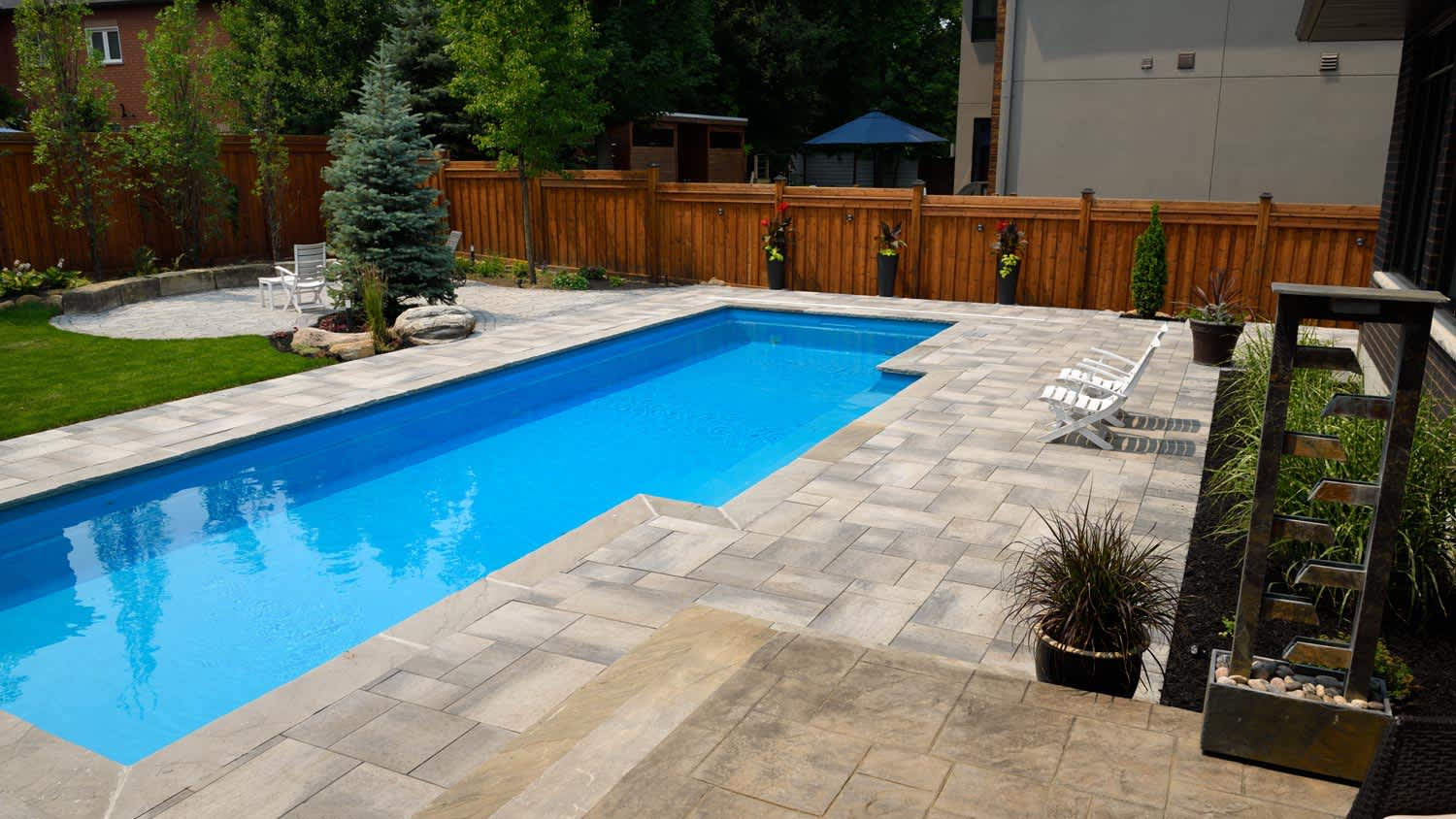
Fiberglass pools are a solid choice. If you are looking into installing one at home, read this guide to learn all the ins and outs of fiberglass pool costs.
Learn which pool material will work swimmingly in your yard

Fiberglass swimming pools versus concrete pools differ in customization, as fiberglass pools arrive prefabricated while concrete pools are built on-site to your exact specifications.
Expect to pay $25,100 to $49,000 for fiberglass pool installation and $35,000 to $65,000 for concrete, making fiberglass the more budget-friendly option for your backyard.
Concrete pools outlast fiberglass pools in lifespan, as concrete can reach 50 years or more while fiberglass lasts 25 to 30 years with proper care.
Hiring a local swimming pool installation professional keeps your project on track, from excavation and shell placement to managing the months-long concrete pour and finishing work.
When you’re looking to add a backyard pool, you may be overwhelmed by the wide array of options. One decision you’ll have to make is which material your pool will be made of, and often the choice will come down to a fiberglass versus concrete pool. Our guide will help you learn key differences between the two and show you how they match up in different categories, such as appearance and lifespan, so you can pick the one that meets your needs.

If you’re trying to decide between these two types of pools, it’s important to know some key differences. Because fiberglass pools are poured using a pre-fabricated mold, they’re not as customizable when it comes to shape and size as concrete pools are. Fiberglass pools also have a shorter lifespan than concrete pools. Concrete pools, meanwhile, are more expensive to install and require more maintenance than fiberglass.
| Concrete | Fiberglass |
|---|---|
| Can be any shape or size | Less expensive to install |
| Durable, long-lasting material | Lasts 25–30 years |
| Easier to repair damage | Quicker to install |
| Lasts longer (up to 50 years) | Lower maintenance costs |
| Requires more maintenance | Smooth surface is easy to walk on |

Fiberglass pools are made from a pre-built fiberglass shell. The smooth surface is comfortable on your feet and resists algae growth. Most fiberglass pools have a gel coat finish to make them more durable.
| Pros | Cons |
|---|---|
| Low installation costs | Variable quality |
| Easy to maintain | Limited shapes and sizes |
| Quick installation | Expensive to ship |
Best For:
Homeowners who want to spend less time on maintenance
Those with a shorter installation timeframe
Budget-conscious homeowners
One of the biggest advantages of fiberglass pools is that they have low pool maintenance costs. They are resistant to algae growth, and they don't require resurfacing as much as concrete pools. The pool's gel coating not only protects the pool, but it also gives it a smooth look and feel. It also makes these pools a lot easier to clean.
Another advantage is that a local pool installer can install a fiberglass pool very quickly—usually within a few days. After excavating, your installer simply lowers the fiberglass shell into the ground.
If you're buying a fiberglass pool, you don't really know its quality until long after installation. That's because, with fiberglass, there are many options for resins and gel coatings, and some are higher quality. If you choose a contractor that uses a lower-quality resin or gel coating, the fiberglass may wear down more quickly, and you may not discover this until years after installation. That's why you'll need to choose your builder carefully if you go this route.
Fiberglass pools, which manufacturers must form in a mold ahead of time, are often expensive to ship because they’re so large. Manufacturers pour on-site, but a fiberglass pool sometimes must ship across the country, costing thousands of dollars.
Also, if you have a specific design in mind for a pool, you may be out of luck. Fiberglass pools require a mold for creation, and a mold may not exist in the design you want.

Concrete pools are made on-site with concrete that’s either sprayed onto steel rebar or poured into concrete forms. They’re endlessly customizable and have an impressive lifespan, but they also have a high price tag.
| Pros | Cons |
|---|---|
| Completely customizable | Higher up-front cost |
| Durable | Longer installation time |
| Withstands extreme temperatures | Requires more regular maintenance |
Best For:
Homeowners looking for a custom shape or size
Those looking for a pool that will last decades to come
Anyone who doesn’t mind keeping up with regular maintenance
One huge advantage of concrete pools is that they’re constructed on-site, so you can choose any shape or design you like.
Another attribute of concrete pools that makes them so popular is their durability. A concrete pool can handle frequent use and hot and cold temperatures without showing much wear and tear. It can last 50 years or more, assuming it is properly taken care of and the surface is replastered every 10 to 15 years.
The length of installation might be the biggest drawback of concrete pools. It is a long and involved process that can take up to six months in some situations. Partially, as a result of this, concrete pools are typically more expensive than other types of pools. And the more you customize it, the pricier it will get.
Concrete pools also require extensive maintenance to prevent issues like algae buildup. They must be cleaned weekly, meaning you'll have to pay for regular pool maintenance, which can add a lot to the overall price of your pool.

Here’s a look at fiberglass vs concrete pools when it comes to texture, ease of repair, and more:
The cost to build a fiberglass pool is between $25,100 and $49,000, whereas the cost to build a pool made from concrete is between $35,000 and $65,000. Fiberglass pools are more affordable because they arrive at your home prefabricated, compared to concrete pools, which are constructed on-site.
Because of the endless customization options for concrete compared to fiberglass, it gets the edge here. That said, if customization isn't important to you and you like the gel coating finish better, you might prefer fiberglass.
Fiberglass has a clear advantage here. Fiberglass pools are shipped to your door and go into a hole in your backyard. The time it takes to build these pools typically ranges from a few days to a few weeks.
It takes much longer to install a concrete pool as pros must install rebar and formwork and pour concrete into the desired shape. From there, the concrete must cure for an extended period of time before any finishing materials, such as plaster and tile, can be installed. The entire process can take anywhere from two to six months.
Due to the texture of each material, the different types of pool finishes can make a difference in how the pool feels while you’re using it. Fiberglass pools have a smooth finish, while concrete is much rougher. The gel coat finish on a fiberglass pool feels glossy, and steps or ledges may have an anti-slip texture that is a little less smooth. Concrete pools have a plaster surface that can sometimes be uncomfortable to walk on. The aggregate can be polished to remove some of the roughness, but it still will not be as smooth as fiberglass.
The difference between fiberglass and concrete pools in terms of operation costs is minimal. Homeowners will spend around $300 per year for electricity for pumps, lighting, and temperature control as part of a pool’s maintenance costs. This price can fluctuate depending on the efficiency of your pump but doesn't necessarily depend on the type of pool.
Fiberglass earns the checkmark when it comes to ease of pool maintenance. Concrete requires weekly scrubbing to keep it free of algae. Fiberglass is easy to clean and won't require nearly as much maintenance, which also means you won’t spend as much money on chemicals.
Besides day-to-day maintenance, concrete pools require long-term upkeep that fiberglass pools do not. You'll have to replace the plaster finish for a concrete pool every 10 to 15 years. Expect to spend about $6,500 per 1,000 square feet for the cost of resurfacing a concrete pool.
If you have a saltwater pool or want to convert your chlorine pool, be aware that salt water can damage the plaster and grout in a concrete pool. This is due to the salt water raising the alkalinity of the water. Eventually, you’ll have to resurface the pool to take care of the damage.
The same does not hold true for fiberglass pools, so if you plan to use salt water, it might be the better option for you.
Both pools last a long time, but concrete still has fiberglass beat. While fiberglass can last 25 to 30 years, concrete pools can last 50 years or more.
Joseph did a great job with the staircase and trim. Timely and efficient, clear communication about the work, very fair pricing. For the stairs in particular, done very skillfully in an old house (1893) in a tight spiral, and very creative with how to do the handrail. Did a nice job with...
 Vouis Trim Carpentry L.L.C.
This company does it right. Firstly, I want to say that Landan was a joy to work with. He was so kind, transparent, and had everything under control. His entire team showed up ready to work and they were all very respectful of the fact that we were in an office space. A little backstory – we...
 Krumlauf Floors
Professional Team, smooth to communication chain and schedule flexibility. Follows proper construction procedure and completes task on time.
 Pegasus Concrete
Very professional, knowledgeable and helpful! Completed the install on time and as expected.
 Ward's Services
Cole has been handling plumbing and general contracting for our four properties over the past three years, and he’s always done a great job. Most recently, he installed a sink and countertop in our retail store where none existed before, and it turned out exactly how we needed. He’s...
 ANB Renovations LLC
Excellent, Prompt, Courteous Service!!! They were super friendly and quite personable. I felt very comfortable with the gentlemen that did the installation. They installed it exactly where I asked them to and they did an excellent job!! I loved their service so much.
 Tether House
I hired windows depot USA of central to install new windows in house in Oshawa. Ilya was very professional from the start, not only did he offered a great price, he also made sure the installation was on time. I am very satisfied with final outcome. The windows look great and the overall...
 Window Depot USA of Central Ohio
The guys did an outstanding job and we had a great experience with CarifaTile. I appreciated that Joe reviewed the quotes with me and set expectations prior to the install. The crews showed up as scheduled and always left the areas clean upon leaving the house. We will definitely use...
 CarifaTile
Did an amazing job transforming my yard. Also installed sod in places, would recommend to everyone.
 Cardinal Landscaping & Construction LLC
Always been satisfied with the service work and how they have taken care of my pool.
From average costs to expert advice, get all the answers you need to get your job done.
Fiberglass pools are a solid choice. If you are looking into installing one at home, read this guide to learn all the ins and outs of fiberglass pool costs.
Spool pool costs vary based on the design and materials, but they’re relatively affordable and space-saving compared to traditional pools. Here’s a cost breakdown.
Removing a pool is a labor-intensive job, but the investment can be worth it. Use this pool removal cost guide to estimate how much you’ll pay for the service.
Fiberglass pools versus vinyl pools—what’s the best choice? Compare cost, maintenance, durability, and customization to find the perfect pool for your backyard.
Gunite pools are more expensive, but they last longer and can be customized. Learn about gunite vs fiberglass pools in this complete guide.

Concrete pools are some of the most durable on the market, but this high-end material isn’t right for everyone. Here are some pros, cons, and comparisons.